
AUTHORS
Stacey Halpern
Department of Biology, Pacific University, Forest Grove, OR 97116
(shalpern@pacificu.edu)THE ISSUE
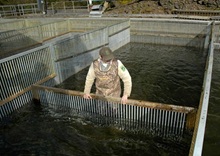
Salmon populations are imperiled in many parts of their range. Salmon play critical roles in ecosystems; for example, they provide key food for predatory animals and deposit nutrients in inland ecosystems when their bodies decompose after spawning. They are also culturally important to many indigenous nations in the Pacific Northwest and economically important to some commercial fisheries and indigenous nations. Therefore, management to increase their population sizes receives a great deal of attention and resources. Fish hatcheries have a long history as a central tool in managing salmon populations. They may also affect salmon in unexpected ways by changing the evolutionary pressures during early life stages. This figure set focuses on the evolution of a consequential salmon life history trait (egg size) in hatcheries and implications for salmon management and recovery.
FOUR-DIMENSIONAL ECOLOGY EDUCATION (4DEE) FRAMEWORK
- Core Ecological Concepts:
- Populations
- Ecology Practices:
- Quantitative reasoning and computational thinking
- Data analysis and interpretation
- Human-Environment Interactions:
- Human impacts on the environment from local to global scales
- Ecological ethics
- Cross-cutting Themes:
- Structure & function
- Evolution
- Space & time
Integration across 4DEE Dimensions
All dimensions are incorporated into this figure set analysis. The key emphasis is on the connections between the core ecological concept of life history evolution (including trade-offs), the ecological practice of data interpretation, and the effects of human activities (namely, fish hatcheries). These inherently incorporate cross-cutting themes, especially related to evolution of organismal traits in different locations and across time.
STUDENT-ACTIVE APPROACHES
- Pre-analysis: team readiness assessment scratch-off quiz
- Figure 1: describe and interpret a figure in small teams, make a prediction
- Figure 2: describe and interpret a figure in small teams, make a management recommendation
STUDENT ASSESSMENTS
Individual readiness assessment quiz, Team readiness assessment quiz, Team data analysis answers, Management recommendation (written)
CLASS TIME
one 65-minute class period
COURSE CONTEXT
Intermediate (second-year) or upper-division (third and fourth-year) courses in Ecology; students should have prior knowledge of basic evolutionary processes from an introductory biology course, or from the course in which the figure analysis occurs. Could be used in Introductory Ecology if students have already learned pre-requisite evolutionary topics. Background in demography and population models helps (e.g., for understanding life history trade-offs such as offspring size vs. number), but the figures could be used in their absence, with modification of some questions or more background provided before the figure analysis.
DOWNLOADS
ACKNOWLEDGMENTS
This activity was improved greatly through feedback from years of Ecology students at Pacific University—thanks! The manuscript benefited from feedback from Michelle Prysby, Christopher Beck, and one anonymous reviewer.
CITATION
Stacey Halpern. January 2026. Does captive breeding help or hinder salmon recovery? Evidence from life history evolution. Teaching Issues and Experiments in Ecology, Vol. 22: Practice #1. https://tiee.esa.org/vol/v22/issues/figure_sets/halpern/abstract.html