
VOLUME 22: Table of Contents
TEACHING ISSUES AND EXPERIMENTS IN ECOLOGY
AUTHORSJennifer E. Slate1 and Pamela Geddes2 1Department of Biology, Northeastern Illinois University (NEIU), 5500 N. Saint Louis Avenue, Chicago, Illinois 60625 2Department of Biology and Environmental Sciences Program, Northeastern Illinois University (NEIU), 5500 N. Saint Louis Avenue, Chicago, Illinois 60625 Corresponding author: Jennifer E. Slate (jeslate@neiu.edu) ABSTRACTStudents conduct a multi-week field and lab-based research project, over six class periods, to examine ecosystem properties that may be impacted by an invasive plant or promote its spread. We focus on Rhamnus cathartica (buckthorn), common in forests of the Upper Midwest, but any plant invader can be chosen and the activity adapted accordingly. Students measure a variety of ecosystem properties, including soil chemistry and biodiversity, at sites with and without the plant invader. They work in teams to develop a research question, collect samples, analyze data, and present results to the class. Each student also conducts a literature search, keeps a field and lab notebook, and writes a paper in scientific format that is revised after peer review. In addition to learning about the ecology of invasive species, students increase their analytical, written, and oral communication skills.
FOUR-DIMENSIONAL ECOLOGY EDUCATION (4DEE) FRAMEWORK
Integration across 4DEE DimensionsAll dimensions are integrated in this field study. Students investigate how an invasive plant alters forest ecosystems by measuring soil characteristics and biodiversity across sites with varying invasion intensity. Working in small groups, they develop research questions, collect and analyze field and laboratory data, and interpret statistical results to identify ecological patterns. By measuring variables related to nutrient cycling and decomposition, students examine interactions between biotic and abiotic ecosystem components. They communicate results through scientific writing and conference-style oral presentations, connect their findings to the primary literature, and consider implications for local management and restoration efforts. CLASS TIMEThe activity is conducted during six class periods of 2-2.5 hours (total of 12-15 hours). Students work in small groups to 1) develop a research question, 2) collect samples in the field, 3) analyze samples in the lab, 4) interpret data and conduct statistics, 5) give an oral presentation of results, and 6) conduct peer review of classmates' written papers. Instructors can focus on specific parts of this activity (e.g., 1 through 3 only) to make the activity shorter and smaller in scope. OUTSIDE OF CLASS TIMEAbout 15 hours outside of class are needed to complete assignments. These tasks include reading and interpreting the primary literature, conducting data analysis, preparing an oral presentation, and writing a paper in standard scientific format (Abstract, Introduction, Methods, Results, Discussion, Acknowledgments, and Literature Cited sections). STUDENT PRODUCTSEach of the six class periods has an associated assignment. We provide handouts for all assignments with goals, instructions, and expectations.
SETTINGField work is conducted at a site impacted by the plant invader and at a relatively unaffected site. Ideally, the sites are in close proximity. We have chosen a local nature preserve that is in the process of removing a common invader in our area, Rhamnus cathartica (hereafter buckthorn), but that still contains affected areas. Students identify the invasive plant through leaf or twig morphology, depending upon the season. Soil and leaf litter samples are collected at both sites and brought back to the lab for processing and analysis. COURSE CONTEXTWe conduct this research activity with a 300-level General Ecology course with lecture and laboratory. Students are encouraged to take it as early as possible in the biology major, and it fulfills a writing-intensive course requirement. Students learn to keep a field and lab notebook, create graphs, make presentation slides, and write a research paper. The maximum class size is 24. INSTITUTIONNortheastern Illinois University is an urban, public and federally designated Hispanic Serving Institution. Our student body of about 5,800 is primarily undergraduate and many attend part time. Although we are a 4-year university, many of our students transfer from community colleges and about 40% are the first in their families to attend college. TRANSFERABILITYBecause invasive plant species are common in all regions, instructors can easily adapt this activity for any invasive plant species, in any ecosystem. Although our students study a common invasive, terrestrial plant in the Upper Midwest (buckthorn), the activity can be tailored to any area with problematic plant invaders, including aquatic ecosystems. We provide protocols for measuring a variety of biotic and abiotic variables, which instructors can choose from as appropriate for local ecosystems and as resources and time allow. Instructors may also include some or all of the assignments we created. We designed the activity for biology majors, but invasive species are of wide interest and expectations for student work can be adjusted for non-majors and for high schoolers. Many parks, nature preserves, and other natural areas open to the public have invasive plant species and are accessible to those with disabilities. DOWNLOADSDescription of other Resource Files: ACKNOWLEDGMENTSWe thank Robert Porter, Liza Fischel, and the Chicago Park District for access to sampling sites at the North Park Village Nature Center in Chicago, Illinois. We greatly appreciate Jim Steffen at the Chicago Botanic Garden for providing inspiration for this activity and for helping us brainstorm about variables that students could test. The Biology Department at Northeastern Illinois University and its staff, Kip Conwell, Jennifer Sevilla, and Sara Crow, gave invaluable help by procuring all necessary supplies and equipment. Finally, we thank the many students in our General Ecology classes who participated in this activity over the years and gave feedback. CITATIONJennifer E. Slate and Pamela Geddes. February 2026. Invasive plants and their relationship to ecosystem properties: a multi-week authentic research project. Teaching Issues and Experiments in Ecology, Vol. 22: Experiment #1. https://tiee.esa.org/vol/v21/experiments/slate/abstract.html |
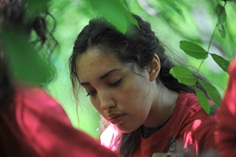
In this activity, students conduct field and labwork to investigate the ecosystem impacts of an invasive plant. (Photo by: Todd Crawford) |
<top> | |